
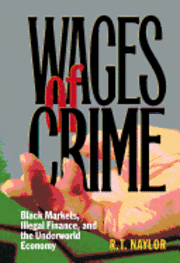
Wages of Crime
Black Markets, Illegal Finance, and the Underworld Economy
Häftad, Engelska, 2005
379 kr
Beställningsvara. Skickas inom 5-8 vardagar. Fri frakt för medlemmar vid köp för minst 249 kr.
"Never in history has there been a black market tamed from the supply side. From Prohibition to prostitution, from gambling to recreational drugs, the story is the same. Supply-side controls act to encourage production and increase profits. At best a few intermediaries get knocked out of business. But as long as demand persists, the market is served more or less as before. In the meantime, failure to 'win the war' [against crime] becomes a pretext for increasing police budgets, expanding law enforcement powers, and pouring more money into the voracious maw of the prison-industrial complex."—from the IntroductionR. T. Naylor specializes in the study of smuggling, black markets, and international financial crime. Wages of Crime takes the reader into the shadowy underworld of modern criminal business—arms trafficking, gold smuggling, money laundering, and terrorist financing. Naylor dissects the schemes by which illegal entrepreneurs disguise their acts, manage their take, and eventually enjoy the loot. The author asserts that much of what police, press, politicians, and the public understand about international crime is based on myth and misrepresentation. A fully revised final chapter covering events since the book's initial publication in early 2002 brings Wages of Crime up to date.
Produktinformation
- Utgivningsdatum2005-02-15
- Mått155 x 235 x undefined mm
- Vikt907 g
- FormatHäftad
- SpråkEngelska
- Antal sidor400
- Upplaga2
- FörlagCornell University Press
- ISBN9780801489600
Tillhör följande kategorier
Hoppa över listan
Mer från samma författare
Wages of Crime: Black Markets, Illegal Finance, and the Underworld Economy
R. T. Naylor
Inbunden
749 kr
Hoppa över listan




Du kanske också är intresserad av
Wages of Crime: Black Markets, Illegal Finance, and the Underworld Economy
R. T. Naylor
Inbunden
749 kr
- Nyhet
Omvårdnadens grunder - paket
Sofia Almerud, Annica Backman, Anna-Karin Edberg, Anna Ehrenberg, My Engström, Katarina Göransson, Lena Marmstål Hammar, Stefan Nilsson, Lars Wallin, Helle Wijk, Joakim Öhlén, Lilas Ali, Anette Alvariza, Ann-Christine Andersson, Pia Andersson, Anna Anåker, Charlotta van Eggermont Arwidson, Margareta Asp, Åsa Audulv, Malin Axelsson, Mariette Bengtsson, Eva Benzein, Lena Berg, Monica Bergqvist, Eva-Karin Bergström, Ida Björkman, Catrin Björvell, Angela Bång, Carina Bååth, Josefin Bäckström, Karin Bölenius, David Edvardsson, Rakel Eklund, Inger Ekman, Mirjam Ekstedt, Ann Catrine Eldh, Karin Enskär, Sofia Erestam, Anneli Eriksson, Henrik Eriksson, Marie Ernsth Bravell, Jan Florin, Anna Forsberg, Henrietta Forsman, Anette Forss, Mio Fredriksson, Febe Friberg, Maria Grandahl, Tanja Gustafsson, Agneta Gånemo, Elizabeth Hanson, Malin Hansson, Amanda Hellström, Ingela Henoch, Inger Jansson, Maria Jirwe, Lena Johansson, Pauline Johansson, Unn-Britt Johansson, Birgitta Kerstis, Ann-Sofie Källberg, Ulrika Källman, Anita Kärner Köhler, Cecilia Larsdotter, Margret Lepp, Maria Lindström Nilsson, Mikael Lundmark, Anneli Löf, Lennart Magnusson, Catharina Melander, Jenny Milton, Beata Molin, Annika Nordin, Maria Norinder, Sepideh Olausson, Carina Persson, Kerstin Prignitz Sluys, Josefin Rahmqvist, Birgit Holritz Rasmussen, Anneli Ringblom, Karin C. Ringsberg, Ann Rudman, Ann-Marie Rydholm Hedman, Silje Rysst, Lars Sandman, Regina Santamäki Fischer, Britt-Inger Saveman, Johanna Sjömar, Karin Stenzelius, Anna Strömberg, Annelie J. Sundler, Märtha Sund Levander, Kristina Svantesson, Anna Swall, Susanne Syrén, Pia Tingström, Johanna Ulfvarson, Sara Wallström, Albert Westergren, Lena Wiklund Gustin, Ulrika Winblad
Häftad, 2025
1 569 kr
- Nyhet
Del 1

- Nyhet
Del 6