Beställningsvara. Skickas inom 7-10 vardagar. Fri frakt för medlemmar vid köp för minst 249 kr.
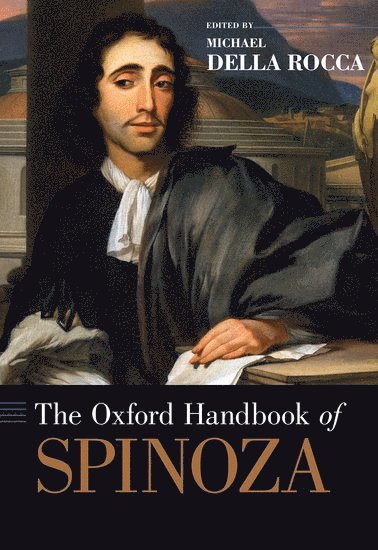
Until recently, Spinoza's standing in Anglophone studies of philosophy has been relatively low and has only seemed to confirm Friedrich Heinrich Jacobi's assessment of him as "a dead dog." However, an exuberant outburst of excellent scholarship on Spinoza has of late come to dominate work on early modern philosophy. This resurgence is due in no small part to the recent revival of metaphysics in contemporary philosophy and to the increased appreciation of Spinoza's role as an unorthodox, pivotal figure--indeed, perhaps the pivotal figure--in the development of Enlightenment thinking.Spinoza's penetrating articulation of his extreme rationalism makes him a demanding philosopher who offers deep and prescient challenges to all subsequent, inevitably less radical approaches to philosophy. While the twenty-six essays in this volume--by many of the world's leading Spinoza specialists--grapple directly with Spinoza's most important arguments, these essays also seek to identify and explain Spinoza's debts to previous philosophy, his influence on later philosophers, and his significance for contemporary philosophy and for humanity.
Michael Della Rocca is Sterling Professor of Philosophy at Yale University where he has taught since 1991. He is the author of Representation and the Mind-Body Problem in Spinoza, Spinoza, The Parmenidean Ascent, and of numerous articles in contemporary metaphysics and early modern philosophy.
ContributorsAbbreviations 1. Introduction Michael Della Rocca2. The Virtues of Geometry Aaron Garrett3. From Maimonides to Spinoza: Three Versions of an Intellectual Transition Kenneth Seeskin4. Spinoza and Descartes Tad M. Schmaltz5. The Building Blocks of Spinoza's Metaphysics: Substance, Attributes, and Modes Yitzhak Y. Melamed6. But Why Was Spinoza a Necessitarian? Charlie Huenemann7. The Principle of Sufficient Reason in Spinoza Martin Lin8. Spinoza and the Philosophy of Science: Mathematics, Motion, and Being Eric Schliesser9. Representation, Misrepresentation, and Error in Spinoza's Philosophy of Mind Don Garrett10. Finite Subjects in the Ethics: Spinoza on Indexical Knowledge, the First Person and the Individuality of Human Minds Ursula Renz11. Spinoza on Skepticism Dominik Perler12. The Highest Good and Perfection in Spinoza John Carriero13. Spinoza on Mind Olli Koistinen14. The Intellectual Love of God Steven Nadler15. The Metaphysics of Affects or the Unbearable Reality of Confusion Lilli Alanen16. Spinoza's Unorthodox Metaphysics of the Will Karolina Hübner17. Eternity Chantal Jaquet18. Spinoza's Philosophy of Religion Carlos Fraenkel19. Spinoza's Political Philosophy Michael A. Rosenthal20. Leibniz's Encounter with Spinoza's Monism, October 1675 to February 1678 Mogens Laerke21. Playing with Fire: Hume, Rationalism, and a Little Bit of Spinoza Michael Della Rocca22. Kant and Spinoza Debating the Third Antinomy Omri Boehm23. "Nothing Comes from Nothing": Judaism, the Orient, and Kabbalah in Hegel's Reception of Spinoza Paul Franks24. Nietzsche and Spinoza: Enemy-BrothersYirmiyahu Yovel25. Spinoza's Afterlife in Judaism and the Task of Modern Jewish Philosophy Michael L. Morgan26. Spinoza's Relevance to Contemporary Metaphysics Samuel Newlands27. Literary Spinoza Rebecca Newberger Goldstein
[an] extremely rich handbook, whose authors include some of the most notable Spinoza and early modern philosophy scholars ... By addressing one of the most complex and rich philosophers of his time, maybe of all times, this scholarship forces us to confront not only past interpretations of his philosophy but also to rethink certain philosophical categories and certain assumptions of what the job of philosophy is.