Beställningsvara. Skickas inom 3-6 vardagar. Fri frakt för medlemmar vid köp för minst 249 kr.
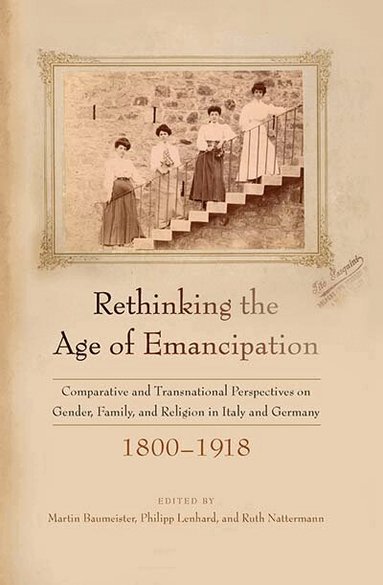
Since the end of the nineteenth century, traditional historiography has emphasized the similarities between Italy and Germany as “late nations”, including the parallel roles of “great men” such as Bismarck and Cavour. Rethinking the Age of Emancipation aims at a critical reassessment of the development of these two “late” nations from a new and transnational perspective. Essays by an international and interdisciplinary group of scholars examine the discursive relationships among nationalism, war, and emancipation as well as the ambiguous roles of historical protagonists with competing national, political, and religious loyalties.
Martin Baumeister is Director of the German Historical Institute in Rome.Philipp Lenhard is Assistant Professor at the Institute of Jewish History and Culture at the Ludwig-Maximilians-University in Munich.Ruth Nattermann is Assistant Professor at the Department of 19th and 20th Century German and European History at the Bundeswehr University Munich. She held post-doctoral positions at the LMU Munich, the German Historical Institute in Rome, and has been principal investigator of the DFG-network "Gender - Nation - Emancipation".
List of IllustrationsAcknowledgementsIntroductionMartin Baumeister, Philipp Lenhard, Ruth NattermannSection 1: Concepts and PerspectivesChapter 1. Nineteenth-Century Italy and Germany beyond National HistoryAmerigo CarusoChapter 2. Rethinking Nation and FamilyIlaria PorcianiSection 2: Family and NationChapter 3. The Morenos between Family and Nation: Notes on the History of a Bourgeois Mediterranean Jewish family (1850-1912)Marcella SimoniChapter 4. Portrait of a "Political Lady": Family Ties and National Activism around 1848 in the Italian and German StatesGiulia FrontoniChapter 5. Emancipation, Religious Affiliation, and Family Status around 1900Angelika SchaserSection 3: Religion and EducationChapter 6. The Legacy of Adam and Eve: Morality and Gender in Jewish "Catechisms" in Nineteenth-Century GermanyPhilipp LenhardChapter 7. The Transformation of Jewish Education in Nineteenth Century Italy: The Meaning of "Catechisms"Silvia GuettaChapter 8. Religion and Nation: Catholic and Protestant Female Education and Cultural Models in Germany (1871-1914)Sylvia SchrautChapter 9. Women for the Homeland: Comparing Catholic and Protestant Female Education in Italy (1848-1908)Liviana GazzettaSection 4: Politics of Women's EmancipationChapter 10. Denomination Matters: Strategies of Self-Designation of the German Women's MovementAnne-Laure BriatteChapter 11. German and Italian Advocates for Women's Emancipation at the International Congress for Women's Achievements and Women's Endeavors in Berlin (1896)Magdalena GehringSection 5: Patriotism and GenderChapter 12. Historian Between Two Fatherlands: Robert Davidsohn and World War IMartin BaumeisterChapter 13. Between Motherhood and Patriotic Duty: Marital Correspondence as a Key Source for the Understanding of French-Jewish Women's Perspectives on the First World WarMarie-Christin LuxSection 6: War and ViolenceChapter 14. 'An Expression of Horror and Sadness'? Non/communication of War Violence Against Civilians in Ego-Documents (Austria-Hungary)Christa HämmerleChapter 15. Hunger, Rape, Escape: The Many Aspects of Violence against Women and Children in the Territories of the Italian FrontNadia Maria FilippiniSection 7: War Experience and MemoryChapter 16. The Construction of the Enemy in Two Jewish Writers: Carolina Coen Luzzatto and Enrica Barzilai GentilliTullia CatalanChapter 17. Heroic Heroic Fathers, Patriotic Mothers, Fallen Sons: National Belonging and Political Positioning in Italian-Jewish Families' Versions of the Great WarRuth NattermannChapter 18. The Commemoration of Jewish Soldiers in AustriaGerald LamprechtIndex
“With a genuinely transnational perspective, this volume avoids the pitfalls of a simple juxtaposition of parallel stories, German and Italian, entrenched in the narrative tradition of national history. It presents an original standpoint on gender as well as Jewish studies.” Asher Salah, Hebrew University of Jerusalem