
Del 1
Del 8 i serien CMS/CAIMS Books in Mathematics
Lucas Sequences
Theory and Applications
Häftad, Engelska, 2024
1 439 kr
Beställningsvara. Skickas inom 10-15 vardagar. Fri frakt för medlemmar vid köp för minst 249 kr.
Finns i fler format (1)
Although the Lucas sequences were known to earlier investigators such as Lagrange, Legendre and Genocchi, it is because of the enormous number and variety of results involving them, revealed by Édouard Lucas between 1876 and 1880, that they are now named after him. Since Lucas’ early work, much more has been discovered concerning these remarkable mathematical objects, and the objective of this book is to provide a much more thorough discussion of them than is available in existing monographs. In order to do this a large variety of results, currently scattered throughout the literature, are brought together. Various sections are devoted to the intrinsic arithmetic properties of these sequences, primality testing, the Lucasnomials, some associated density problems and Lucas’ problem of finding a suitable generalization of them. Furthermore, their application, not only to primality testing, but also to integer factoring, efficient solution of quadratic and cubic congruences, cryptography and Diophantine equations are briefly discussed. Also, many historical remarks are sprinkled throughout the book, and a biography of Lucas is included as an appendix.Much of the book is not intended to be overly detailed. Rather, the objective is to provide a good, elementary and clear explanation of the subject matter without too much ancillary material. Most chapters, with the exception of the second and the fourth, will address a particular theme, provide enough information for the reader to get a feel for the subject and supply references to more comprehensive results. Most of this work should be accessible to anyone with a basic knowledge of elementary number theory and abstract algebra. The book’s intended audience is number theorists, both professional and amateur, students and enthusiasts.
Produktinformation
- Utgivningsdatum2024-10-20
- Mått155 x 235 x 18 mm
- Vikt487 g
- FormatHäftad
- SpråkEngelska
- SerieCMS/CAIMS Books in Mathematics
- Antal sidor301
- FörlagSpringer International Publishing AG
- ISBN9783031372407
Tillhör följande kategorier
Hoppa över listan
Mer från samma serie
Del 1
Del 2
Del 2
Del 3
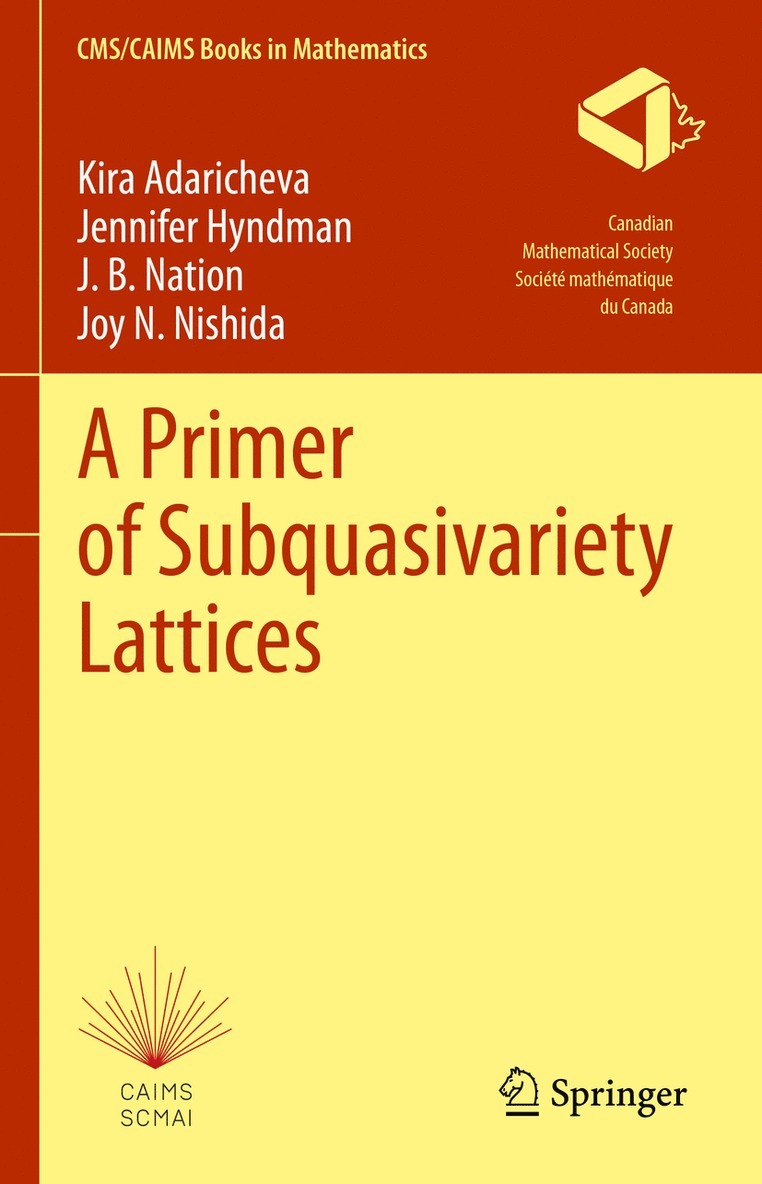
Primer of Subquasivariety Lattices
Kira Adaricheva, Jennifer Hyndman, J. B. Nation, Joy N. Nishida
Inbunden, 2022
1 869 kr
Del 3
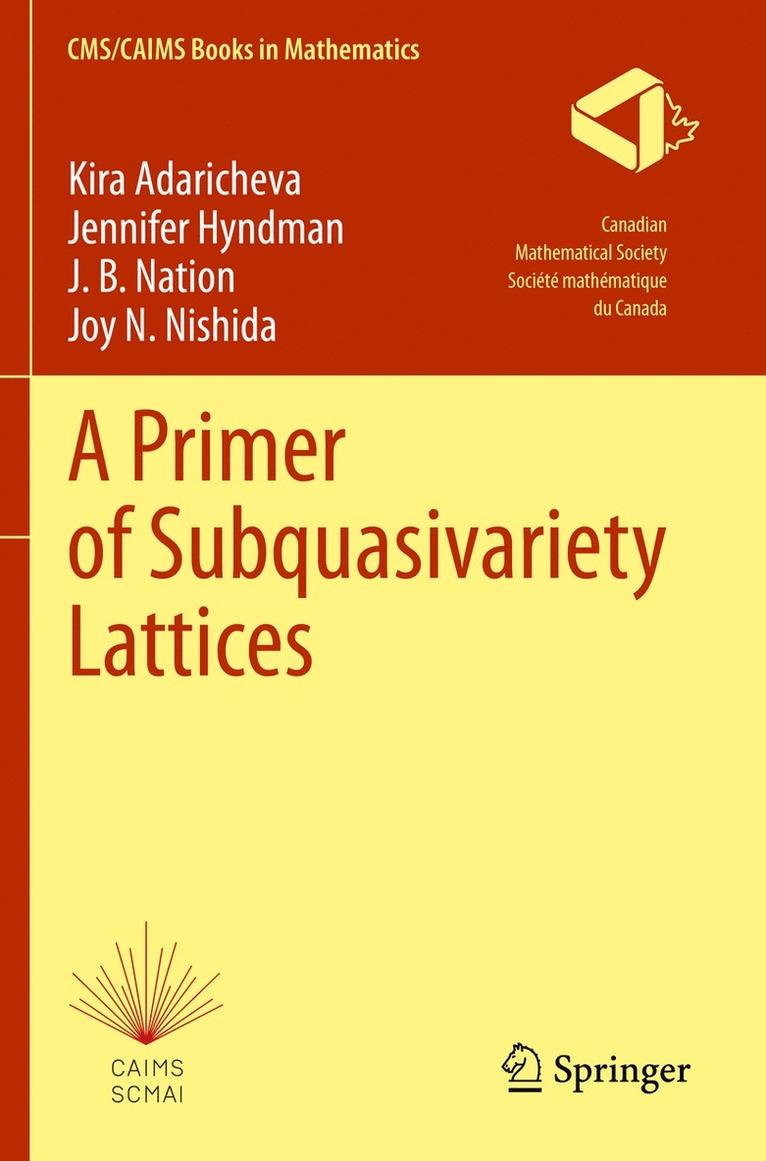
Primer of Subquasivariety Lattices
Kira Adaricheva, Jennifer Hyndman, J. B. Nation, Joy N. Nishida
Häftad, 2023
1 299 kr
Del 4
Del 4
Del 5
Numerical Methods for Solving Discrete Event Systems
Winfried Grassmann, Javad Tavakoli
Inbunden, 2022
1 219 kr
Del 5
Numerical Methods for Solving Discrete Event Systems
Winfried Grassmann, Javad Tavakoli
Häftad, 2023
869 kr
Hoppa över listan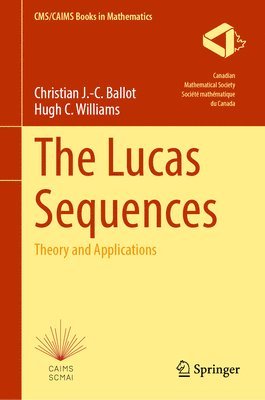


Du kanske också är intresserad av
Del 8
Del 16
Del 23
Public-Key Cryptography and Computational Number Theory
Kazimierz Alster, Jerzy Urbanowicz, Hugh C. Williams
Inbunden, 2001
3 219 kr
Del 16
Computational Number Theory
Attila Pethoe, Michael Pohst, Hugh C. Williams, Horst G. Zimmer
Inbunden, 1991
2 089 kr
- Nyhet
Del 3