Del 168 - Studies in Critical Social Sciences
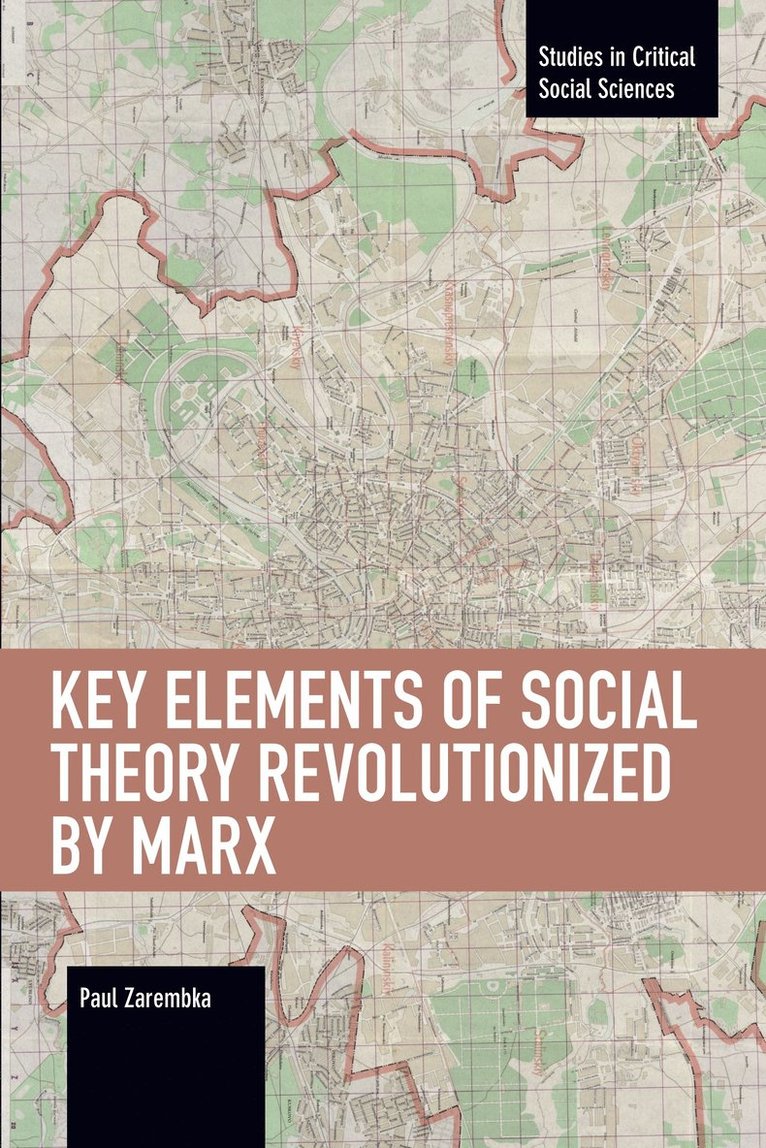
Key Elements of Social Theory Revolutionized by Marx
3 179 kr
Beställningsvara. Skickas inom 5-8 vardagar. Fri frakt för medlemmar vid köp för minst 249 kr.
Finns i fler format (1)
Produktinformation
- Utgivningsdatum2020-09-24
- Mått155 x 235 x 21 mm
- Vikt554 g
- FormatInbunden
- SpråkEngelska
- SerieStudies in Critical Social Sciences
- Antal sidor274
- FörlagBrill
- ISBN9789004432697
Tillhör följande kategorier
Paul Zarembka is Professor of Economics, State University of New York at Buffalo, and general editor since 1977 of Research in Political Economy (Emerald). With many articles, and also editing Frontiers in Econometrics (Academic Press, 1974) and The Hidden History of 9-11 (Seven Stories Press, 2008), he is listed in Marquis’ Who’s Who in the World, among other listings. He worked at the International Labor Office in Geneva, Switzerland, was a Fulbright scholar in Poznan, Poland, and is an activist in his academic union.
- List of TablesList of AbbreviationsNote on the Citing of Capital, Volume IIntroductionPart 1: The Atrophy of Philosophy1 The Problem of Hegel1 Hegel and Capital, Volume I, 1st German Edition2 2nd German and French Editions of Volume I3 Sieber on Marx and Criticizing His Use of Hegel; Marx’s Reaction3.1 Sieber’s 1871 Book3.2 Sieber, Mikhaylovsky and Marx, 1874–18773.3 1881: Marx’s Comment on Sieber and Reply to Zasulich4 After Marx’s 1883 Death, Sieber’s Decline and Plekhanov’s Influence5 Lenin’s Evolution toward Dialectical Materialism6 ConclusionPart 2: Key Elements of Political Economy2 Marx’s Evolution and Revolution with the Concept of Value1 Poverty of Philosophy (1847): economic Concepts Historically Conditioned2 Contribution (1859): abstract Labor as the Substance of Value3 Capital, Volume I (1867): labor Power4 Other Additions in Volume I: a) Socially Necessary Labor Time, b) Form of Value, c) Labor Time in Constant Capital4.1 Socially Necessary Labor Time4.2 Form of Value4.3 Labor Time Embodied in Constant Capital5 Marx’s Retrospective on Value3 Not Engels, but Marx’s Final Edition of Capital, Volume I (1882)1 Marx’s Capital, Volume I: Parts I–VI2 Volume I: the Structural Divisions Desired by Marx, Contrasted to Engels’ Editions3 Marx’s Parts VII and VIII (1882) Compared with Engels’ 3rd Edition (1883)4 Text: “The General Law of Capitalist Accumulation”, Sections 1–4, as Desired by Marx (1882)1 Section 1: the Increased Demand for Labour-Power that Accompanies Accumulation, the Composition of Capital Remaining the Same2 Section 2: changes in the Composition of Capital with the Progress of Accumulation and Relative Diminution of that Part of Capital that is Exchanged against Labor Power3 Section 3: progressive Production of a Relative Surplus-Population or Industrial Reserve Army4 Section 4: different Forms of the Relative Surplus-Population. The General Law of Capitalist Accumulation5 Section 5: illustrations of the General Law of Capitalist Accumulation5 Marx on Primitive Accumulation Contrasted to Engels’ Handling of It 1 Why, for Marx, Primitive Accumulation became a New Part VIII2 Engels’ Handling of the English (1887) and 4th German (1890) Editions of VolumeI3 Engels’ Continuing Failure to Recognize Marx’s Advances4 Postscript: Marx’s Primitive Accumulation Conflated with Modern Dispossessions/Enclosures6 Marxist Accumulation of Capital?1 Accumulation of Capital in Capital, Volume I2 Schemes of Reproduction in Capital, Volume II3 Ambiguity4 “Marxist Accumulation of Capital”5 An Algebraic Model of Marxist Accumulation with Fixed Constant Capital Included7 Three Troubling Issues 1 Conundrum: value under Marxist Accumulation of Capital2 Sieber’s Query of Value in Marx3 Prejudices of Marx and Engels8 The Composition of Capital Clarified Theoretically, Empirically1 Materialized Composition of Capital and the Rate of Profit2 Luxemburg’s Recognition of the Materialized Composition, Considering It to be Rising3 Marx’s and Engels’ Estimations for Cotton Spinning4 Estimates of the Composition of Capital, Post-World War II5 Updated Estimation for the United States5.1 Introduction by Shaikh of a Revised Methodology for Capital Stock Measurement5.2 Quality Adjustment in Capital Stock Measurement5.3 Paitaridis and Tsoulfidis’ Implementation of Shaikh’s Methodology5.4 Sector Estimates6 Limitations of the Current Discussion9 Luxemburg’s Accumulation of Capital and Consideration of the Evidence1 The Issue Luxemburg Addressed2 Luxemburg’s Critique of Marx on Accumulation and Her Response to Bauer’s Criticism2.1 Bauer’s Critique and Luxemburg’s Reply3 Criticism of Luxemburg’s Accumulation after her Death: Bukharin to Shaikh4 Luxemburg Gets Assists from Robinson and Kowalik5 Historical Accumulation and Fraction of Surplus Value RequiredPart 3: Considering Nationalism and State Machiavellianism10 Luxemburg’s “The National Question and Antonomy” and Lenin’s CriticismNarihiko Ito1 The Features of Luxemburg’s Theory on the National Question2 The Polish Question and Marx and Engels3 Luxemburg’s “The National Question and Autonomy”3.1 Negation of the Right of National Self-determination3.2 Abolition of the Nation-State3.3 Centralization or Local Autonomy3.4 Conditions of “National Autonomy”3.5 The Domain of “Polish Autonomy”3.6 Is “The National Question and Autonomy” an Unfinished Work?4 Lenin’s Criticism4.1 Lenin’s Criticism4.2 Nation-State vs. Autonomy4.3 Theoretical Differences between Lenin and Luxemburg and Historical Reality4.4 Luxemburg’s Theory on the National Question5 Epilogue11 Marxism, Machiavellianism, and Conspiracy Theory1 A Limitation of Marxist Theory of the National State2 Marx on Louis Bonaparte’s Conspiratorial Coup3 Were Wars Initiated by Provocations, Prevarications, or False-Flags? Some Background3.1 “Spotty Lincoln” and the Mexican-American War3.2 The Explosion of the USS Maine and the Spanish-American War3.3 Assassination of Archduke Ferdinand3.4 Mukden or Manchurian Incident3.5 Reichstag Burning and the Gleiwitz Incident3.6 The Second Gulf of Tonkin Incident before Escalation in Vietnam4 “Conspiracy Theory” Becomes a Weapon of the State after the Assassination of John F. Kennedy5 Dismissing a Jury Trial Conviction of State Conspiracy in the Assassination of Martin Luther King, Jr.6 Utilization of the “Conspiracy Theory” Weapon: the World Trade Center and the Pentagon in 20016.1 Alleged Muslim Hijackers6.2 Falling Skyscrapers6.3 The Pentagon6.4 Calls from Planes?6.5 Insider Trading6.6 September 11th and Conspiracy Theory6.7 ConclusionReferences Index
“The virtue of Zarembka’s book is that it examines the different ways in which Marx made a contribution to the social sciences. It offers to the reader much that is original and significant.… He explains in clear and accessible language key concepts of Marx’s economics, and how these have been interpreted by writers such as Rosa Luxemburg. This is a book which can be highly recommended both to specialists in Marx’s ideas and to the wider reading public.”-- James D. White, Critical Sociology, 47:7/8 (Nov 2021, pp. 1349-1353)
Mer från samma författare
Neoliberalism in Crisis, Accumulation, and Rosa Luxemburg's Legacy
Susanne Soederberg, Paul Zarembka
1 749 kr
Mer från samma serie
Varieties of Post-communist Capitalism
Ivn Szelenyi, Peter Mihlyi, Iván Szelényi, Péter Mihályi, Péter Szelényi, Iván
439 kr
Hybrid Identities: Theoretical And Empirical Examinations
Keri Smith, Keri E. Iyall Smith, Patricia Leavy, Keri E Iyall Smith
509 kr
Dialectic Of Solidarity: Labor, Antisemitism, And The Frankfurt School
Mark Worrall, Mark P. Worrell, Mark P Worrell
439 kr
Liberal Modernity And Its Adversaries: Freedom, Liberalism And Anti-liberalism In The 21st Century
Milan Zafirovski
619 kr
Marx's Scientific Dialectics: A Methodological Treatise For A New Century
Paul Paolucci, Paul Paolucci
439 kr
Imperialism, Neoliberalism, And Social Struggles In Latin America
Richard A. Dello Buono, Richard A. Dello Buono, José Bell Lara, Richard A Dello Buono
439 kr
Marx, Critical Theory And Religion: A Critique Of Rational Choice
Warren S. Goldstein, Warren S. Goldstein, Warren S Goldstein
519 kr
Globalization And The Environment
Andrew Jorgenson, Andrew Jorgenson Jorgenson, Edward Kick
419 kr
Du kanske också är intresserad av
Neoliberalism in Crisis, Accumulation, and Rosa Luxemburg's Legacy
Susanne Soederberg, Paul Zarembka
1 749 kr
Class History and Class Practices in the Periphery of Capitalism
Paul Zarembka, USA) Zarembka, Paul (State University of New York at Buffalo
1 489 kr
Analytical Gains of Geopolitical Economy
Radhika Desai, Canada) Desai, Radhika (University of Manitoba, Paul Zarembka
1 819 kr