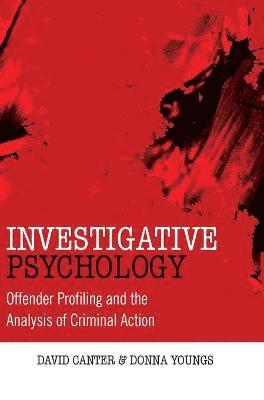
This ground-breaking text is the first to provide a detailed overview of Investigative Psychology, from the earliest work through to recent studies, including descriptions of previously unpublished internal reports. Crucially it provides a framework for students to explore this exciting terrain, combining Narrative Theory and an Action Systems framework. It includes empirically tested models for Offender Profiling and guidance for investigations, as well as an agenda for research in Investigative Psychology.Investigative Psychology features: The full range of crimes from fraud to terrorism, including burglary, serial killing, arson, rape, and organised crime.Important methodologies including multi-dimensional scaling and the Radex approach as well as Social Network Analysis.Geographical Offender Profiling, supported by detailed analysis of the underlying psychological processes that make this such a valuable investigative decision support tool.The full range of investigative activities, including effective information collection, detecting deception and the development of decision support systems.In effect, this text introduces an exciting new paradigm for a wide range of psychological contributions to all forms of investigation within and outside of law enforcement. Each chapter has actual cases and quotations from offenders and ends with questions for discussion and research, making this a valuable text for undergraduate and postgraduate courses in Applied and Forensic Psychology, Criminology, Socio-Legal Studies and related disciplines.
Professor David Canter and Dr Donna Youngs are both of the International Research Centre for Investigative Psychology (IRCIP), UK.
Preface xiAcknowledgements xvPart I The Road to Investigative Psychology 1The Emergence of Investigative Psychology from Offender Profiling1 Introducing Investigative Psychology 3Psychology and Investigations 5The Emergence of IP 8Origins in ‘Offender Profiling’ 8The Investigative Cycle 10Disciplines Drawn On by IP 15Mind the Gap – Bridging Policing and Psychology 15System Integration versus Expert Opinion 18Questions that Investigative Psychologists Ask 19Beyond Crime and Criminals 23Linking Theory and Practice – The Book Ahead 23Summary 24Further Reading 25Questions for Discussion and Research 252 Foundations: Description and Classification 27Psychology and Investigations 28Historical Background 29‘Profiling’ Emerges 37The Significance of Inference 40Investigative Psychology and Offender Profiling 41Summary 41Further Reading 42Questions for Discussion and Research 433 The Coming of the Informed Detective 45Medical Contributions 46From Fact to Fiction to Fact 47Distinguishing Deduction and Induction 52Reverse Diagnosis 52Serial Killers 53Jack the Ripper 54Beyond Speculation 56Summary 57Further Reading 57Questions for Discussion and Research 584 The Age of Profiling and the Road to Investigative Psychology 59Understanding Criminal Actions 60The Emergence of Investigative Advice 67The FBI Behavioral Science Unit 72The Emergence of Investigative Psychology 73Summary 76Further Reading 77Questions for Discussion and Research 78Part II Fundamentals 79A Framework for Studying Criminal Actions and Inferences about Offenders5 The Radex of Criminality 81The A→C Equations 83The Hierarchy of Criminal Variation 88A Model of Criminal Variation 96The Radex of Criminality 111Development and Change 113Summary 116Further Reading 117Questions for Discussion and Research 1186 Personal Narratives of Crime 119The Narratives of Criminality 121Empirical Study of Criminal Narratives 126Scripts and Narratives 135Summary 136Further Reading 137Questions for Discussion and Research 1377 Finding Action Patterns and Drawing Profiles 139Criminal Actions 140Salience 144The Basis for Inferences 148An Action System of Crime Differentiation 155The Example of Arson 157Narratives as Action Systems 160Forms of Inference: Towards a Narrative Action System Model of Inference 162Summary 164Further Reading 165Questions for Discussion and Research 1658 Criminal Psychogeography 167Modelling Criminals’ Use of Space 169The Behavioural Approach and Propinquity 171The Cognitive Approach and Morphology of Crime Locations 176Settings for Personal Narratives 181The Value of Imaginary Maps 186Temporal Changes 192Emotionality, Crime Type and Distance 193Challenges to the Study of Criminal Geography 193Research Agenda 196Summary 196Further Reading 197Questions for Discussion and Research 1979 Investigative Information 199The Challenges of Investigative Information 201Weaknesses in Identification and Eyewitness Testimony 211Investigative Interviewing 215Interview Procedures 217The Cognitive Interview 218PACE and PEACE 221Research Approach to Investigative Information 222Summary 226Further Reading 228Questions for Discussion and Research 22910 Suspect Interviewing and Deception 231The People of the Drama: Explanatory Roles in the Investigation of Crime 233Strengths and Constraints of Investigative Information 233Suspects 236Ekman’s IEE Approach 237Psychophysiological Lie Detectors 239The Reid Approach to Interrogation 240False Confessions 242False Allegations 242Written Accounts 244Summary 248Further Reading 248Questions for Discussion and Research 249Part III Profiling Criminal Actions 251Models of Offending Behaviour and Applications of Investigative Psychology11 Acquisitive Crime 253Differentiating Acquisitive Crime 255Problems with Typologies 256Burglary 257Modelling Burglary 260Offending Styles: A Narrative Action System for Burglary 262Robbery 267Modelling Robbery 270Modelling Fraud 275Differentiating Fraud and Fraudsters 276Narratives of Fraud 283Summary 284Further Reading 285Questions for Discussion and Research 28512 Sexual Offences 287The Role of the Victim in Violent Crime 288Strategies for Destruction of the Person 291Differentiating Rape 295Identifying Different Styles of Rape Action 300Characteristics of Rapists 302Sexual Assaults on Males 303Stalking 305Summary 314Further Reading 315Questions for Discussion and Research 31513 Murder 317Murder 319Offending Style in Murder: Understanding the Context of the Encounter 319Contract Murder 322Serial Murder 327Sexual Murder 344Offender Characteristics 349Summary 353Further Reading 353Questions for Discussion and Research 35414 Organised Crime 355The Social Nature of Crime 356What is Organised Crime? 358Cultural Ideologies and Criminal Networks 359Criminal ‘Careers’ within Criminal ‘Organisations’ 361Social Network Analysis 363Destructive Organisational Psychology 372Summary 374Further Reading 374Questions for Discussion and Research 37515 Terrorism 377The Great Variety of Terrorism 378Difficulties in Studying Terrorists 379Modes of Terrorism 382Explanations for Terrorism 384Terrorism as Process 386Summary 390Further Reading 391Questions for Discussion and Research 39116 Investigative Psychology in Action 393Helping the Police with their Enquiries 394Assessment and Improvement of Investigative Information 395Decision Support Systems 399Dragnet and Other Geographical Profiling Systems 404Linking Cases (Comparative Case Analysis) 408Emerging Areas of IP 415Six Fundamentals of IP 418The Wider Reaches of an Investigative Psychology 424Conclusions 425Further Reading 426Questions for Discussion and Research 426Glossary 429References 437Index 461