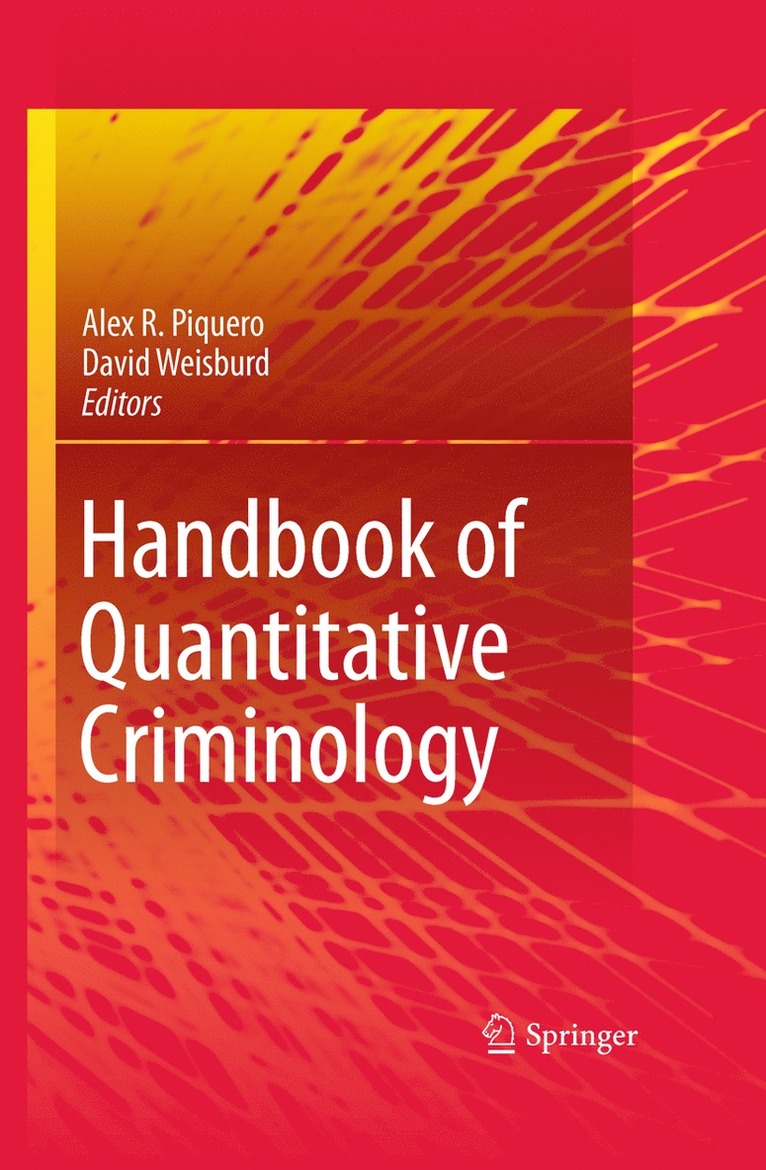
Handbook of Quantitative Criminology
Häftad, Engelska, 2011
1 699 kr
Produktinformation
- Utgivningsdatum2011-08-09
- Mått178 x 254 x 42 mm
- Vikt1 500 g
- FormatHäftad
- SpråkEngelska
- Antal sidor787
- FörlagSpringer-Verlag New York Inc.
- ISBN9781461413882
Tillhör följande kategorier
Alex R. Piquero is a Professor at the University of Maryland Department of Criminal Justice and Criminology, Member of the MacArthur Foundation's Research Network on Adolescent Development, and Member of the National Consortium on Violence Research. He is also Executive Counselor of the American Society of Criminology, and is Co-Editor of the Journal of Quantitative Criminology. He received a Ph.D. in Criminology & Criminal Justice from the University of Maryland in 1996, and has received several teaching, research, and mentoring awards, including the American Society of Criminology Young Scholar and E-Mail Mentor of the Year Awards, and a University of Florida Teacher of the Year Award. His research interests include criminal careers, criminological theory, and quantitative research methods. He has published widely in the fields of criminology, criminal justice, psychology, and sociology, and is co-author (with Alfred Blumstein and David Farrington) of a recently published book, Key Issues in Criminal Careers Research. David Weisburd is Walter E. Meyer Professor of Law and Criminal Justice and Director of the Institute of Criminology at the Hebrew University Faculty of Law, and Distinguished Professor of Administration of Justice at George Mason University. He is an elected Fellow of the American Society of Criminology and of the Academy of Experimental Criminology. He is also Co-Chair of the steering committee of the Campbell Collaboration Crime and Justice Group, a member of the Harvard University/National Institute of Justice Executive Session in Policing, and of the National Research Council Committee on Crime, Law and Justice. Professor Weisburd has a long interest in Crime and Place studies beginning with his involvement in a series of experimental studies of police interventions at crime places, including the Minneapolis Hot Spots Experiment, the Jersey City Drug Market Analysis Experiment and the Jersey City Violent Crime Hot Spots Experiment. Professor Weisburd is presently working on a book with Liz Groff and SueMing Yang that explores the varying factors that explain variation in developmental trends of crime at micro places over time that will be published by Oxford University Press. Professor Weisburd is author or editor of fifteen books and more than eighty scientific articles.
- Descriptive Approaches for Research and Policy: Innovative Descriptive Methods for Crime and Justice Problems.- Crime Mapping: Spatial and Temporal Challenges.- Look Before You Analyze: Visualizing Data in Criminal Justice.- Group-Based Trajectory Modeling: An Overview.- General Growth Mixture Analysis with Antecedents and Consequences of Change.- Spatial Regression Models in Criminology: Modeling Social Processes in the Spatial Weights Matrix.- Mixed Method Research in Criminology: Why Not Go Both Ways?.- Descriptive Approaches for Research and Policy: New Estimation Techniques for Assessing Crime and Justice Policy.- Estimating Costs of Crime.- Estimating Treatment Effects: Matching Quantification to the Question.- Meta-analysis.- Social Network Analysis.- Systematic Social Observation in Criminology.- New Directions in Assessing Design, Measurement and Data Quality.- Identifying and Addressing Response Errors in Self-Report Surveys.- Missing Data Problems in Criminological Research.- The Life Event Calendar Method in Criminological Research.- Statistical Power.- Descriptive Validity and Transparent Reporting in Randomised Controlled Trials.- Measurement Error in Criminal Justice Data.- Statistical Models of Life Events and Criminal Behavior.- Estimation of Impacts and Outcomes of Crime and Justice: Topics in Experimental Methods.- An Introduction to Experimental Criminology.- Randomized Block Designs.- Construct Validity: The Importance of Understanding the Nature of the Intervention Under Study.- Place Randomized Trials.- Longitudinal-Experimental Studies.- Multisite Trials in Criminal Justice Settings: Trials and Tribulations of Field Experiments.- Estimation of Impacts and Outcomes of Crime and Justice: Innovation in Quasi-Experimental Design.- Propensity Score Matching in Criminology and Criminal Justice.- Recent Perspectives on the Regression Discontinuity Design.- Testing Theories of Criminal Decision Making: Some Empirical Questions about Hypothetical Scenarios.- Instrumental Variables in Criminology and Criminal Justice.- Estimation of Impacts and Outcomes of Crime and Justice: Non-Experimental Approaches to Explaining Crime and Justice Outcomes.- Multilevel Analysis in the Study of Crime and Justice.- Logistic Regression Models for Categorical Outcome Variables.- Count Models in Criminology.- Statistical Analysis of Spatial Crime Data.- An Introduction to Statistical Learning from a Regression Perspective.- Estimating Effects over Time for Single and Multiple Units.
Du kanske också är intresserad av
The Oxford Handbook of Developmental and Life-Course Criminology
David P. Farrington, Lila Kazemian, Alex R. Piquero, University of Cambridge) Farrington, David P. (Emeritus Professor Psychological Criminology, Emeritus Professor Psychological Criminology, Institute of Criminology, John Jay College of Criminal Justice) Kazemian, Lila (Associate Professor of Sociology, Associate Professor of Sociology, University of Texas at Dallas) Piquero, Alex R. (Ashbel Smith Professor in the Program in Criminology, Ashbel Smith Professor in the Program in Criminology, School of Economic, Political, and Policy Sciences
2 429 kr