
Del 7
Del 45 i serien Studies in Celtic History
Growth of Law in Medieval Wales, c.1100-c.1500
Inbunden, Engelska, 2022
1 469 kr
Beställningsvara. Skickas inom 5-8 vardagar. Fri frakt för medlemmar vid köp för minst 249 kr.
Finns i fler format (1)
2022 Hywel Dda Award (University of Wales Literary Awards)A ground-breaking study of the lawbooks which were created in the changing social and political climate of post-conquest Wales.The Middle Ages in Wales were turbulent, with society and culture in constant flux. Edward I of England's 1282 conquest brought with it major changes to society, governance, power and identity, and thereby to the traditional system of the law. Despite this, in the post-conquest period the development of law in Wales and the March flourished, and many manuscripts and lawbooks were created to meet the needs of those who practised law.This study, the first to fully reappraise the entire corpus of law manuscripts since Aneurin Owen's seminal 1841 edition, begins by considering the background to the creation of the law from the earliest period, particularly from c.1100 onwards, before turning to the "golden age" of lawmaking in thirteenth-century Gwynedd. The nature of the law in south Wales is also examined in full, with a particular focus on later developments, including the different use of legal texts in that region and its fourteenth- and fifteenth-century manuscripts. The author approaches medieval Welsh law, its practice, texts and redactions, in their own contexts, rather than through the lens of later historiography. In particular, she shows that much manuscript material previously considered "additional" or "anomalous" in fact incorporates new legal material and texts written for a particular purpose: thanks to their flexible accommodation of change, adjustment and addition, Welsh lawbooks were not just shaped by, but indeed shaped, medieval Welsh law.
Produktinformation
- Utgivningsdatum2022-08-23
- Mått156 x 234 x 20 mm
- Vikt488 g
- FormatInbunden
- SpråkEngelska
- SerieStudies in Celtic History
- Antal sidor270
- FörlagBoydell & Brewer Ltd
- ISBN9781783277261
- UtmärkelserWinner of Hywel Dda Award (University of Wales Literary Awards) 2022 (UK)
Tillhör följande kategorier
Hoppa över listan
Mer från samma serie
Del 3
Del 4
Chronicles and Annals of Mediaeval Ireland and Wales
Kathryn Grabowski, David N. Dumville
Inbunden, 1984
1 479 kr
Del 8
Church and the Welsh Border in the Central Middle Ages
Christopher N L Brooke, David N. Dumville, David N. Dumville
Inbunden, 1986
1 429 kr
Del 14
Del 15
Del 18
Irish Identity of the Kingdom of the Scots in the Twelfth and Thirteenth Centuries
Dauvit Broun
Inbunden, 1999
1 479 kr
Del 16
Del 5
Del 6
Del 9
Hoppa över listan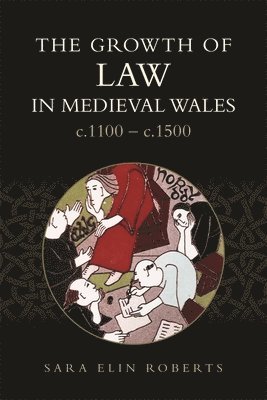

Du kanske också är intresserad av
Del 45
Del 7
Del 10
Del 7
Del 43
Del 27
Del 9
Del 35
Del 21
Del 3