
Del i serien University of California Press
Great Wall of Confinement
The Chinese Prison Camp through Contemporary Fiction and Reportage
Häftad, Engelska, 2004
559 kr
Beställningsvara. Skickas inom 5-8 vardagar. Fri frakt för medlemmar vid köp för minst 249 kr.
China is the only major world power to have entered the twenty-first century with a thriving prison camp network - a frightening, mostly hidden realm known since 1951 as the laogai system. This book, the most comprehensive study of China's prison camps to date, draws from a wide range of primary sources, including many compelling literary documents, to illuminate life inside China's prison camps. Focusing mainly on the second half of the twentieth century, Philip F. Williams and Yenna Wu outline the evolution of the laogai system, construct a vivid picture of prisoners' lives from arrest and interrogation to release, and provide a troubling new perspective on the human rights issues plaguing China.
Produktinformation
- Utgivningsdatum2004-08-17
- Mått152 x 229 x 18 mm
- Vikt454 g
- FormatHäftad
- SpråkEngelska
- SerieUniversity of California Press
- Antal sidor260
- FörlagUniversity of California Press
- ISBN9780520244023
Tillhör följande kategorier
Hoppa över listan





Du kanske också är intresserad av
Southern Discourse in Sinophone Literature
Chia-rong Wu, Min-xu Zhan, Alison Groppe, Yenna Wu
Inbunden, 2025
3 689 kr
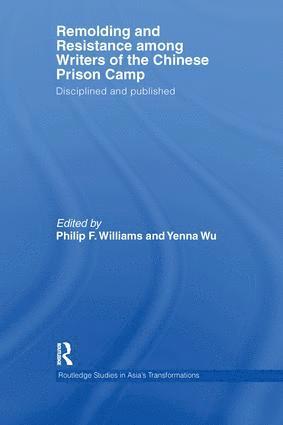
Remolding and Resistance Among Writers of the Chinese Prison Camp
Philip Williams, Yenna Wu
Inbunden, 2006
3 199 kr
Remolding and Resistance Among Writers of the Chinese Prison Camp
Philip Williams, Yenna Wu
Häftad, 2016
959 kr
Human Rights, Suffering, and Aesthetics in Political Prison Literature
Yenna Wu, Simona Livescu, Yenna Wu, Simona Livescu
Häftad, 2013
1 049 kr
- Nyhet
Del 3
- Nyhet
Del 4