
Emmy Noether's Wonderful Theorem
Häftad, Engelska, 2017
479 kr
Skickas . Fri frakt för medlemmar vid köp för minst 249 kr.
"In the judgment of the most competent living mathematicians, Fraulein Noether was the most significant creative mathematical genius thus far produced since the higher education of women began."-Albert Einstein The year was 1915, and the young mathematician Emmy Noether had just settled into Gottingen University when Albert Einstein visited to lecture on his nearly finished general theory of relativity. Two leading mathematicians of the day, David Hilbert and Felix Klein, dug into the new theory with gusto, but had difficulty reconciling it with what was known about the conservation of energy. Knowing of her expertise in invariance theory, they requested Noether's help. To solve the problem, she developed a novel theorem, applicable across all of physics, which relates conservation laws to continuous symmetries-one of the most important pieces of mathematical reasoning ever developed. Noether's "first" and "second" theorem was published in 1918. The first theorem relates symmetries under global spacetime transformations to the conservation of energy and momentum, and symmetry under global gauge transformations to charge conservation.In continuum mechanics and field theories, these conservation laws are expressed as equations of continuity. The second theorem, an extension of the first, allows transformations with local gauge invariance, and the equations of continuity acquire the covariant derivative characteristic of coupled matter-field systems. General relativity, it turns out, exhibits local gauge invariance. Noether's theorem also laid the foundation for later generations to apply local gauge invariance to theories of elementary particle interactions. In Dwight E. Neuenschwander's new edition of Emmy Noether's Wonderful Theorem, readers will encounter an updated explanation of Noether's "first" theorem. The discussion of local gauge invariance has been expanded into a detailed presentation of the motivation, proof, and applications of the "second" theorem, including Noether's resolution of concerns about general relativity. Other refinements in the new edition include an enlarged biography of Emmy Noether's life and work, parallels drawn between the present approach and Noether's original 1918 paper, and a summary of the logic behind Noether's theorem.
Produktinformation
- Utgivningsdatum2017-05-27
- Mått150 x 226 x 20 mm
- Vikt454 g
- FormatHäftad
- SpråkEngelska
- Antal sidor344
- Upplaga2
- FörlagJohns Hopkins University Press
- ISBN9781421422671
Tillhör följande kategorier
Hoppa över listan


Mer från samma författare
"Yours Ever, Freeman": The Wisdom Of Freeman Dyson
Neuenschwander Dwight E, Dwight E Neuenschwander
Inbunden
1 069 kr
"Yours Ever, Freeman": The Wisdom Of Freeman Dyson
Neuenschwander Dwight E, Dwight E Neuenschwander
Häftad
719 kr
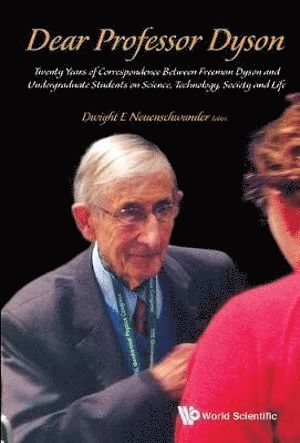
Dear Professor Dyson: Twenty Years Of Correspondence Between Freeman Dyson And Undergraduate Students On Science, Technology, Society And Life
Neuenschwander Dwight E, Dwight E Neuenschwander
Inbunden
1 119 kr
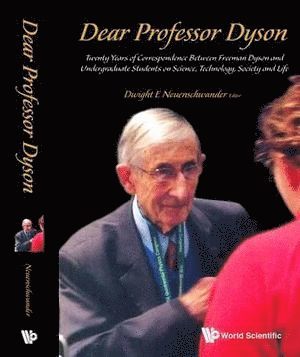
Dear Professor Dyson: Twenty Years Of Correspondence Between Freeman Dyson And Undergraduate Students On Science, Technology, Society And Life
Neuenschwander Dwight E, Dwight E Neuenschwander
Häftad
539 kr
Hoppa över listan





Du kanske också är intresserad av
- Signerad
Del 1

- Nyhet
- Nyhet
Del 2
- Nyhet
- Nyhet
Del 7
- Nyhet
Del 1