Beställningsvara. Skickas inom 7-10 vardagar. Fri frakt för medlemmar vid köp för minst 249 kr.
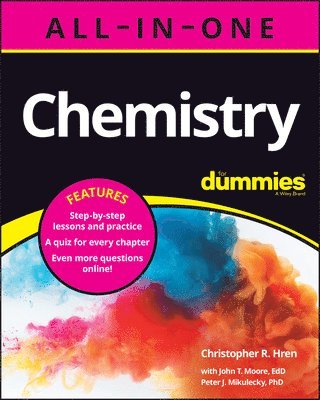
Take the confusion out of chemistry with hundreds of practice problems Chemistry Workbook For Dummies is your ultimate companion for introductory chemistry at the high school or college level. Packed with hundreds of practice problems, this workbook gives you the practice you need to internalize the essential concepts that form the foundations of chemistry. From matter and molecules to moles and measurements, these problems cover the full spectrum of topics you'll see in class—and each section includes key concept review and full explanations for every problem to quickly get you on the right track. This new third edition includes access to an online test bank, where you'll find bonus chapter quizzes to help you test your understanding and pinpoint areas in need of review. Whether you're preparing for an exam or seeking a start-to-finish study aid, this workbook is your ticket to acing basic chemistry. Chemistry problems can look intimidating; it's a whole new language, with different rules, new symbols, and complex concepts. The good news is that practice makes perfect, and this book provides plenty of it—with easy-to-understand coaching every step of the way. Delve deep into the parts of the periodic tableGet comfortable with units, scientific notation, and chemical equationsWork with states, phases, energy, and chargesMaster nomenclature, acids, bases, titrations, redox reactions, and moreUnderstanding introductory chemistry is critical for your success in all science classes to follow; keeping up with the material now makes life much easier down the education road. Chemistry Workbook For Dummies gives you the practice you need to succeed!
Christopher Hren is a high school chemistry teacher and former track and football coach. Peter J. Mikulecky, PhD, teaches biology and chemistry at Fusion Learning Center and Fusion Academy.
Introduction 1About This Book 1Foolish Assumptions 2Icons Used in This Book 2Beyond the Book 3Where to Go from Here 3Part 1: Getting Cozy With Numbers, Atoms, and Elements 5Chapter 1: Noting Numbers Scientifically 7Using Exponential and Scientific Notation to Report Measurements 7Multiplying and Dividing in Scientific Notation 9Using Exponential Notation to Add and Subtract 10Distinguishing between Accuracy and Precision 12Expressing Precision with Significant Figures 13Doing Arithmetic with Significant Figures 15Answers to Questions on Noting Numbers Scientifically 17Chapter 2: Using and Converting Units 21Familiarizing Yourself with Base Units and Metric System Prefixes 22Building Derived Units from Base Units 23Converting between Units: The Conversion Factor 25Letting the Units Guide You 28Answers to Questions on Using and Converting Units 31Chapter 3: Breaking Down Atoms 33The Atom: Protons, Electrons, and Neutrons 33Deciphering Chemical Symbols: Atomic and Mass Numbers 35Accounting for Isotopes Using Atomic Masses 38Answers to Questions on Atoms 40Chapter 4: Surveying the Periodic Table of the Elements 43Organizing the Periodic Table into Periods and Groups 43Predicting Properties from Periodic and Group Trends 46Seeking Stability with Valence Electrons by Forming Ions 48Putting Electrons in Their Places: Electron Configurations 50Measuring the Amount of Energy (or Light) an Excited Electron Emits 53Answers to Questions on the Periodic Table 55Part 2: Making and Remaking Compounds 57Chapter 5: Building Bonds 59Pairing Charges with Ionic Bonds 60Sharing Electrons with Covalent Bonds 63Occupying and Overlapping Molecular Orbitals 67Polarity: Sharing Electrons Unevenly 70Shaping Molecules: VSEPR Theory and Hybridization 73Answers to Questions on Bonds 78Chapter 6: Naming Compounds and Writing Formulas 81Labeling Ionic Compounds and Writing Their Formulas 81Getting a Grip on Ionic Compounds with Polyatomic Ions 85Naming Molecular (Covalent) Compounds and Writing Their Formulas 87Addressing Acids 89Mixing the Rules for Naming and Formula Writing 91Beyond the Basics: Naming Organic Carbon Chains 93Answers to Questions on Naming Compounds and Writing Formulas 96Chapter 7: Understanding the Many Uses of the Mole 101The Mole Conversion Factor: Avogadro’s Number 102Doing Mass and Volume Mole Conversions 103Determining Percent Composition 106Calculating Empirical Formulas 107Using Empirical Formulas to Find Molecular Formulas 109Answers to Questions on Moles 111Chapter 8: Getting a Grip on Chemical Equations 115Translating Chemistry into Equations and Symbols 116Balancing Chemical Equations 118Recognizing Reactions and Predicting Products 120Combination (synthesis) 120Decomposition 120Single replacement (single displacement) 121Double replacement (double displacement) 121Combustion 123Canceling Spectator Ions: Net Ionic Equations 125Answers to Questions on Chemical Equations 127Chapter 9: Putting Stoichiometry to Work 129Using Mole-Mole Conversions from Balanced Equations 130Putting Moles at the Center: Conversions Involving Particles,Volumes, and Masses 132Limiting Your Reagents 135Counting Your Chickens after They’ve Hatched: Percent Yield Calculations 138Answers to Questions on Stoichiometry 140Part 3: Examining Changes In Terms of Energy 147Chapter 10: Understanding States in Terms of Energy 149Describing States of Matter with the Kinetic Molecular Theory 149Make a Move: Figuring Out Phase Transitions and Diagrams 151Answers to Questions on Changes of State 154Chapter 11: Obeying Gas Laws 155Boyle’s Law: Playing with Pressure and Volume 156Charles’s Law and Absolute Zero: Looking at Volume and Temperature 157The Combined and Ideal Gas Laws: Working with Pressure, Volume, andTemperature 159Mixing It Up with Dalton’s Law of Partial Pressures 162Diffusing and Effusing with Graham’s Law 163Answers to Questions on Gas Laws 165Chapter 12: Dissolving into Solutions 169Seeing Different Forces at Work in Solubility 169Concentrating on Molarity and Percent Solutions 172Changing Concentrations by Making Dilutions 174Altering Solubility with Temperature 175Answers to Questions on Solutions 178Chapter 13: Playing Hot and Cold: Colligative Properties 183Portioning Particles: Molality and Mole Fractions 183Too Hot to Handle: Elevating and Calculating Boiling Points 186How Low Can You Go? Depressing and Calculating Freezing Points 188Determining Molecular Masses with Boiling and Freezing Points 189Answers to Questions on Colligative Properties 191Chapter 14: Exploring Rates and Equilibrium 195Measuring Rates 195Focusing on Factors That Affect Rates 199Measuring Equilibrium 201The equilibrium constant 202Free energy 203Answers to Questions on Rates and Equilibrium 206Chapter 15: Warming Up to Thermochemistry 209Understanding the Basics of Thermodynamics 209Working with Specific Heat Capacity and Calorimetry 212Absorbing and Releasing Heat: Endothermic and Exothermic Reactions 214Summing Heats with Hess’s Law 216Answers to Questions on Thermochemistry 218Part 4: Swapping Charges 221Chapter 16: Working with Acids and Bases 223Surveying Three Complementary Methods for Defining Acids and Bases 224Method 1: Arrhenius sticks to the basics 224Method 2: Brønsted-Lowry tackles bases without a hydroxide ion 225Method 3: Lewis relies on electron pairs 226Measuring Acidity and Basicity: pH, pOH, and KW 228Ka and Kb: Finding Strength through Dissociation 230Answers to Questions on Acids and Bases 233Chapter 17: Achieving Neutrality with Titrations and Buffers 237Concentrating on Titration to Figure Out Molarity 238Maintaining Your pH with Buffers 241Measuring Salt Solubility with Ksp 244Answers to Questions on Titrations and Buffers 245Chapter 18: Accounting for Electrons in Redox 247Oxidation Numbers: Keeping Tabs on Electrons 247Balancing Redox Reactions under Acidic Conditions 250Balancing Redox Reactions under Basic Conditions 252Answers to Questions on Electrons in Redox 255Chapter 19: Galvanizing Yourself to Do Electrochemistry 259Identifying Anodes and Cathodes 259Calculating Electromotive Force and Standard Reduction Potentials 263Coupling Current to Chemistry: Electrolytic Cells 266Answers to Questions on Electrochemistry 269Chapter 20: Doing Chemistry with Atomic Nuclei 273Decaying Nuclei in Different Ways 273Alpha decay 274Beta decay 274Gamma decay 275Measuring Rates of Decay: Half-Lives 276Making and Breaking Nuclei: Fusion and Fission 277Answers to Questions on Nuclear Chemistry 279Part 5: The Part of Tens 281Chapter 21: Ten Chemistry Formulas to Tattoo on Your Brain 283Chapter 22: Ten Annoying Exceptions to Chemistry Rules 289Index 295