
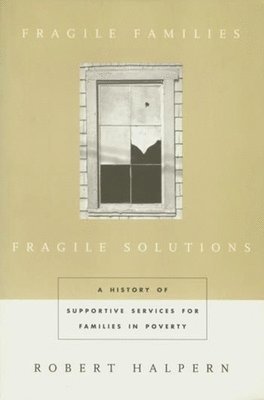
Fragile Families, Fragile Solutions
A History of Supportive Services for Families in Poverty
Inbunden, 1998
1 159 kr
Tillfälligt slut
How has America's social welfare network benefited families living in poverty? In what ways has it failed to provide for their needs? The system of social welfare in the United States has had lasting impact on the lives of many people in need, it is far from perfect in its handling of the nation's poor. This text presents a historical perspective on one of the central components of the US social welfare network - family services - and provides a look at the advances this service network has achieved, problems it has confronted, and where it is likely to go in the future. Beginning with an exploration of the 19th century roots of family services and the emergence of family casework at the beginning of the 20th century, Robert Halpern ranges through the 1920s and 1930s, charting the influence of psychoanalytic theory in social service work and government responses to the Depression. He surveys the following decades, when policymakers attempted to respond to changing inner-city populations. The text covers a wide spectrum of issues in policy and organization, as well as escalating crises in such areas as child welfare.
Produktinformation
- Utgivningsdatum1998-09-04
- Mått152 x 229 x undefined mm
- Vikt420 g
- FormatInbunden
- FörlagColumbia University Press
- ISBN9780231106665
Tillhör följande kategorier
Hoppa över listan








Du kanske också är intresserad av
- Nyhet
Del 3
- Nyhet
Del 6
- Nyhet
- Nyhet
Del 4
- Nyhet
Del 7
- Nyhet
Del 11
- Nyhet
Del 1