Beställningsvara. Skickas inom 10-15 vardagar. Fri frakt för medlemmar vid köp för minst 249 kr.
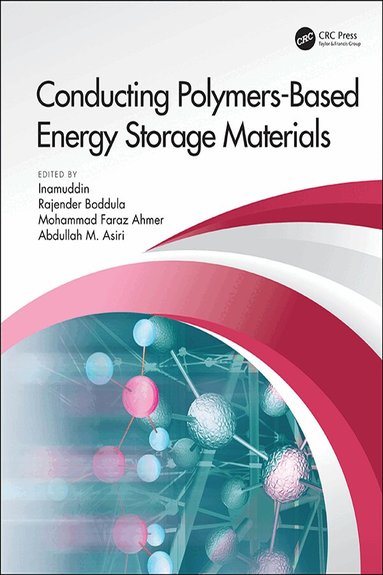
Conducting polymers are organic polymers which contain conjugation along the polymer backbone that conduct electricity. Conducting polymers are promising materials for energy storage applications because of their fast charge–discharge kinetics, high charge density, fast redox reaction, low-cost, ease of synthesis, tunable morphology, high power capability and excellent intrinsic conductivity compared with inorganic-based materials. Conducting Polymers-Based Energy Storage Materials surveys recent advances in conducting polymers and their composites addressing the execution of these materials as electrodes in electrochemical power sources. Key Features: Provides an overview on the conducting polymer material properties, fundamentals and their role in energy storage applications. Deliberates cutting-edge energy storage technology based on synthetic metals (conducting polymers) Covers current applications in next-generation energy storage devices. Explores the new aspects of conducting polymers with processing, tunable properties, nanostructures and engineering strategies of conducting polymers for energy storage. Presents up-to-date coverage of a large, rapidly growing and complex conducting polymer literature on all-types electrochemical power sources. This book is an invaluable guide for students, professors, scientists, and R&D industrial specialists working in the field of advanced science, nanodevices, flexible electronics, and energy science.
Dr Inamuddin, Rajender Boddula, Mohammad Faraz Ahmer, Abdullah Mohamed Asiri
ContentsPreface .......................................................................................................................................................................... viiContributors .................................................................................................................................................................. ixAuthors........................................................................................................................................................................ xiiiChapter 1 Polythiophene-Based Battery Applications.................................................................................................. 1Younus Raza Beg, Gokul Ram Nishad, Chittaranjan Das, and Priyanka SinghChapter 2 Synthetic Strategies and Significant Issues for Pristine Conducting Polymers ............................................51Mriganka Sekhar Manna and Kalyan GayenChapter 3 Conducting Polymer Derived Materials for Batteries .................................................................................65U. Naresh, R. Jeevan Kumar, S. Ramesh, K. Chandra Babu Naidu, D. Baba Basha,Prasun Banerjee, and K. SrinivasChapter 4 An Overview on Conducting Polymer-Based Materials for Battery Application ........................................79Satyabadi Martha and Dilip Kumar MishraChapter 5 Polymer-Based Binary Nanocomposites.....................................................................................................93Pazhanivel Thangavelu, Priyadharshini Matheswaran, and Navaneethan DuraisamyChapter 6 Polyaniline-Based Supercapacitor Applications........................................................................................109Nuzhat Jamil, Sadia Zafar Bajwa, Muhammad Yasir, Asma Rehman, and Waheed S. KhanChapter 7 Conductive Polymer-derived Materials for Supercapacitor ......................................................................123P.E. Lokhande and U.S. ChavanChapter 8 Conducting Polymer-Metal Based Binary Composites for Battery Applications......................................135Aneela Sabir, Dania Munir, Samina Saleem, Faiqa Shakeel, Muhammad Hamad Zeeshan,Muhammad Shafiq, Rafi Ullah Khan, and Karl I JacobChapter 9 Novel Conducting Polymer-Based Battery Application............................................................................145Aneela Sabir, Faiza Altaf, Zahid Bashir, Muhammad Hassan Tariq, Muhammad Khalil,Muhammad Shafiq, Muhammad Hamad Zeeshan, Rafi Ullah Khan, and Karl I JacobChapter 10 Conducting Polymer–Carbon-Based Binary Composites for Battery Applications ..................................155Christelle Pau Ping Wong, Joon Ching Juan, and Chin Wei LaiChapter 11 Polyethylenedioxythiophene-Based Battery Applications .........................................................................161G. Nasymov, J. Swanson, A. M. Numan-Al-Mobin, C. Jahnke, and A. SmirnovaChapter 12 Polythiophene-Based Supercapacitor Applications ..................................................................................177Shankara S. Kalanur, Veerendra Kumar A. Kalalbandi, and Hyungtak SeoChapter 13 Conducting Fibers for Energy Applications .............................................................................................193Narendra Reddy, Roshan Paul, and Asimananda KhandualChapter 14 Conducting Polymer-Metal-Based Binary Composites for Supercapacitor Applications .........................209A.B.V. Kiran Kumar, Swati Chaudhary, and C.H.V.V. RamanaChapter 15 Polyethylenedioxythiophene (PEDOT)-Based Supercapacitor Applications.............................................235Manoj Karakoti, Sandeep Pandey, Nanda Gopal Sahoo, Anirban Dandapat, and Suman MahendiaChapter 16 Electrospun Composite Separator for Li-Ion Batteries: A Short Review..................................................255A. Dennyson Savariraj, R.V. Mangalaraja, G. Bharath, Fawzi Banat, and N. PugazhenthiranChapter 17 Conducting Polymers: Properties, Synthesis, and Energy Storage Devices ...............................................267Mohamad Azuwa Mohamed and Nadhratun Naiim MobarakChapter 18 Applications of Polyethylenedioxythiophene in Photovoltaics..................................................................287Jazib Ali, Mutayyab Afreen, Tahir Rasheed, Muhammad Zeeshan Ashfaq, and Muhammad BilalChapter 19 Conducting Polymer-Based Ternary Composites for Supercapacitor Applications ..................................301Devalina Sarmah and Ashok KumarIndex............................................................................................................................................................................333
. Inamuddin, Rajender Boddula, Mohd Imran Ahamed, Abdullah Mohamed Asiri, China) Boddula, Rajender (National Center for Nanoscience and Technology (NCNST), Beijing, Saudi Arabia) Asiri, Abdullah Mohamed (King Abdulaziz University, Inamuddin, Dr. Inamuddin
Rajender Boddula, Abdullah M. Asiri, Inamuddin, China) Boddula, Rajender (CAS Key Laboratory of Nanosystems and Hierarchical Fabrication, National Center for Nanoscience and Technology, Saudi Arabia) Asiri, Abdullah M. (Chemistry Department, Center of Excellence for Advanced Materials Research, King Abdulaziz University,<br>Jeddah, India) Inamuddin (Assistant Professor, Department of Applied Chemistry, Zakir Husain College of Engineering and Technology, Faculty of Engineering and Technology, Aligarh Muslim University, Aligarh, Dr. Inamuddin
Rajender Boddula, Abdullah M. Asiri, China) Boddula, Rajender (CAS Key Laboratory of Nanosystems and Hierarchical Fabrication, National Center for Nanoscience and Technology, Saudi Arabia) Asiri, Abdullah M. (Chemistry Department, Center of Excellence for Advanced Materials Research, King Abdulaziz University,<br>Jeddah, Dr Inamuddin
Inamuddin, Rajender Boddula, Abdullah M. Asiri, India) Inamuddin (Assistant Professor, Department of Applied Chemistry, Zakir Husain College of Engineering and Technology, Faculty of Engineering and Technology, Aligarh Muslim University, Aligarh, China) Boddula, Rajender (CAS Key Laboratory of Nanosystems and Hierarchical Fabrication, National Center for Nanoscience and Technology, Saudi Arabia) Asiri, Abdullah M. (Chemistry Department, Center of Excellence for Advanced Materials Research, King Abdulaziz University,<br>Jeddah, Dr. Inamuddin